Five takeaways from final debate of Quebec election campaign
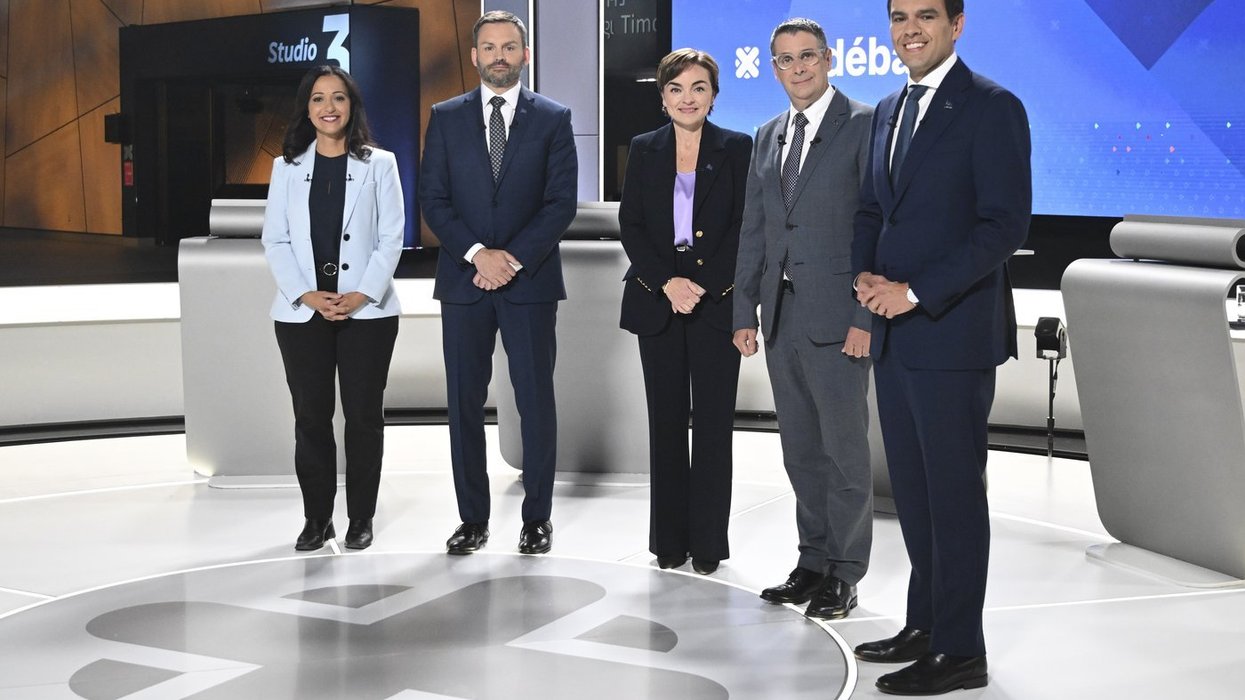
After being greeted by a raucous crowd of supporters and protesters, the leaders of Quebec's five major political parties dove into their third and final debate of the election campaign, hosted by Radio-Canada on Wednesday evening.
Here are five takeaways from a debate featuring Coalition Avenir Québec Leader Christine Fréchette, Quebec Liberal Leader Charles Milliard, Québec solidaire co-spokesperson Ruba Ghazal, Parti Québécois Leader Paul St-Pierre Plamondon and Quebec Conservative Leader Éric Duhaime.
1. There was a one-hour wait for sparring on sovereignty and a referendum.
The leaders discussed five major themes during Wednesday's debate. But voters watching at home had to wait until the second hour to hear one of the evening's most animated exchanges — during a segment about the future of Quebec.
The PQ leader and Québec solidaire's co-spokesperson are both in favour of sovereignty, with slightly different approaches. Ruba Ghazal promoted her plan to get Indigenous people and English-speaking Quebecers to buy into a campaign to make the province a country. This was the only mention of Quebec's English-speaking population in the entire debate.
St-Pierre Plamondon quickly found himself on the defensive over his recent pledge to wait until after U.S. President Donald Trump leaves the White House before triggering a referendum.
Milliard pressed St-Pierre Plamondon on whether this delay was an admission a referendum would weaken Quebec — a theory, the PQ leader dismissed.
"It's proof that we are living a very unusual moment with the Americans that is unacceptable on the part of the Trump administration," St-Pierre Plamondon said in French. "It's not a serene climate (while Trump is president) to reflect on our future."
The PQ leader has pledged to spend $130 million in government to organize a referendum. This would include money for a roving commission to hold consultations on the issue in the years leading up to a vote after January 2029.
Milliard said his rivals all support sovereignty or would have supported it in the past and argued his party was the only federalist option.
Fréchette and Duhaime have said Quebecers are not interested in a referendum.
2. Waiting times in hospitals are still a problem.
Fréchette found herself on the defensive early in the debate after being challenged by her rivals from the Liberals and Parti Québécois about broken health-care promises and long wait times in hospitals after her party's eight years in government.
Milliard said Quebecers had been betrayed by the Coalition Avenir Québec’s promises to reduce emergency room wait times and ensure every Quebecer had a doctor. St-Pierre Plamondon agreed, saying the latter promise was “disrespectful of people’s intelligence.”
Fréchette acknowledged there was still work to do, but said her party had made improvements, including in increasing the number of surgeries performed and signing up hundreds of thousands of Quebecers for groups of family doctors.
3. St-Pierre Plamondon talked a lot.
Radio-Canada tracked how long each leader spoke during the debate.
By the end of the evening, the moderator, Radio-Canada journalist Patrice Roy, allowed the PQ leader to speak for nearly 24 minutes, while the Liberal and Conservative leaders got less than 18 minutes of airtime to talk about their policies and ideas.
Québec solidaire's Ghazal spoke for a little more than 20 minutes, while Fréchette spoke for close to 21 minutes.
4. The baby that shook the campaign landed in debate.
A baby found at a homeless encampment in east Montreal in mid-September became the topic of one of the opening segments of the debate. Police say the discovery triggered an investigation and the intervention of social services and youth protection workers.
The story has brought the plight of unhoused people and affordability issues to the forefront of the Quebec campaign, with the leaders expressing shock and pledging to address them.
Each leader was asked about the incident and had a few seconds to respond before moving on to the next topic.
5. There were five leaders on stage.
Political analysts have said Quebec voters are fragmented in a tight race that could lead to a minority government when ballots are cast Oct. 5.
That dynamic was evident on stage as each leader tried to make their points, with multiple voices in the background.
There was limited opportunity for anyone to take specific aim at a rival before others interrupted or tried to change the topic.
This report by The Canadian Press was first published Sept. 24, 2026
Copyright 2026, The Canadian Press. All rights reserved.