A stunning meteor shower will be visible from Montreal this week — Here's how to see it
You can wish upon a star. 🌠
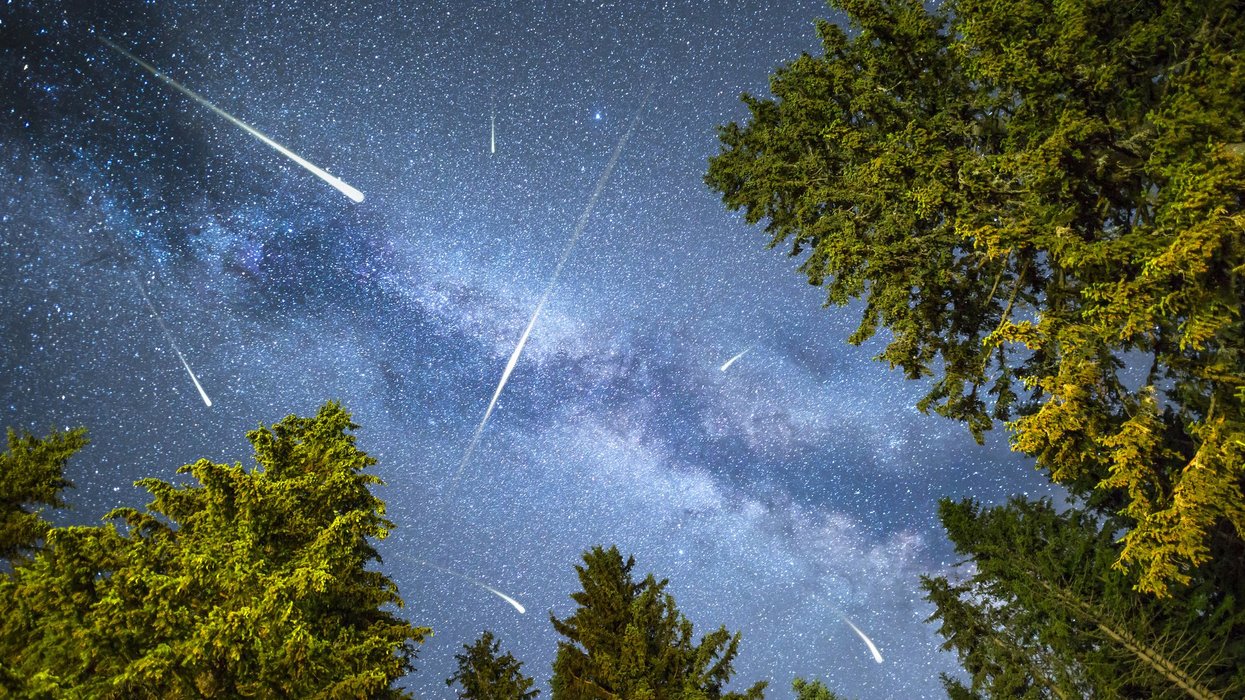
The Orionid meteor shower is set to peak overnight from Wednesday, October 21 to Thursday, October 22.
If you've been looking for an excuse to bundle up and stay outside past your bedtime, the sky just gave you one.
The Orionid meteor shower, one of the most popular celestial events of the year, is set to peak overnight from Wednesday, October 21 to Thursday, October 22. And according to MétéoMédia, the forecast is looking pretty good for stargazers in Montreal.
At its peak, you could see up to 20 meteors an hour under dark, clear skies. That works out to about one every three minutes.
Here's everything you should know about catching a glimpse.
What are the Orionids?
The Orionids happen every year, from around October 2 to November 7, as Earth passes through a cloud of dust and tiny bits of rock left behind by Halley’s comet.
Those particles, often no bigger than a grain of sand, enter the atmosphere at about 66 kilometres per second, or more than 225,000 km/h. They burn up roughly 100 kilometres above the ground, creating what we call shooting stars.
The shower gets its name from the constellation Orion, since that's where the meteors appear to come from. In reality, though, they can show up anywhere in the sky.
Halley's comet itself only passes near Earth about once every 76 years. It was last seen in early 1986, and it won't be back until July 2061. So this is your next best chance to catch a piece of it.
According to MétéoMédia, the Orionids are known for being fast and bright. Some meteors leave behind a glowing trail that lingers for a few seconds, and you might even spot a fireball, a particularly bright shooting star.
The peak is also fairly spread out, so the nights just before and after Wednesday could be worth checking out too.
The moon could get in the way
Everybody likes a bright moon on an autumn night, but it's not ideal for meteor shower viewing.
The moon will be about three-quarters full during the peak, and its glow could wash out some of the fainter meteors, especially earlier in the night.
The trick is to watch during the second half of the night. As dawn gets closer, the moon sinks toward the horizon while Orion climbs higher in the sky, and viewing conditions get a lot better.
The forecast looks good for Montreal
Here's the good news. MétéoMédia says skies should be clear over the Montreal and Quebec City areas on Wednesday night.
Most of the clouds are expected farther north, which is bad news for the Hautes-Laurentides, Abitibi-Témiscamingue, Saguenay and the Côte-Nord.
Thursday night should also be mostly clear across southern Quebec, though a few clouds could roll into the Saguenay, Bas-Saint-Laurent and Gaspésie regions.
How to see the meteor shower
Viewing hours run from 10 p.m. to 6 a.m., but you'll have the most luck early in the morning.
"The best time to observe them is around 5 a.m., when the radiant is highest in the sky," says Montreal Planétarium director Olivier HernandezPlanétarium director Olivier Hernandez.
Here are a few tips to help you make the most of it:
- Get away from city lights. The darker the sky, the more meteors you'll see, so a park or a spot outside the city is your best bet.
- Find Orion. Look for the three stars in a row that make up Orion's belt, rising in the east in the evening.
- Give your eyes time to adjust. It can take 20 to 30 minutes for your eyes to get used to the dark, so try to stay off your phone, or switch it to night mode.
- Dress warmly. MétéoMédia says temperatures will be around normal for the season, but nights will still be chilly, close to freezing.
If you miss it
If the moon, the clouds, or city lights get in the way, don't worry. The Orionids will stay active until November 7.
And the next big meteor shower, the Leonids, will peak overnight from November 17 to 18. The moon will be at its first quarter and should set around midnight, leaving darker skies for the second half of the night.