French-only Quebec election voter guides prompted 160 complaints over five days
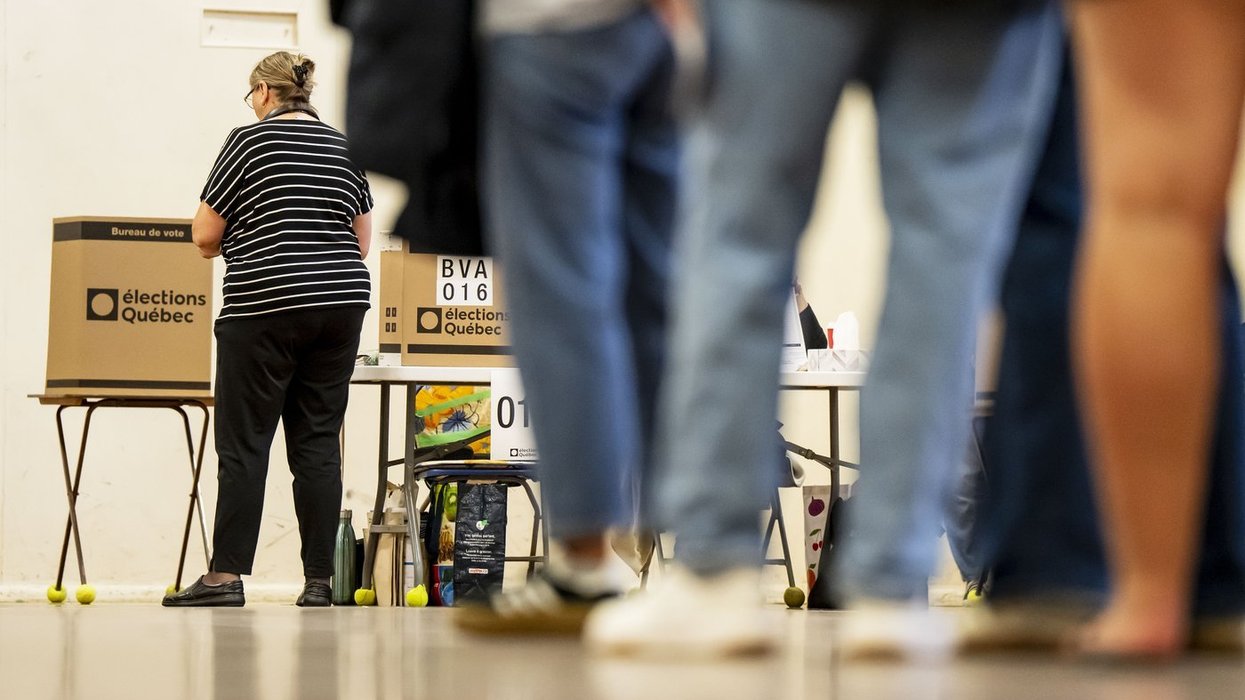
When Derek Heatherington, a retired college professor living in the Eastern Townships region of Quebec, heard that the provincial elections agency was sending out unilingual French information guides this year, he decided to act.
“This situation really spoke to me, because we're getting to the point here where we're talking really about voter suppression,” he said.
Élections Québec announced on its website on Sept. 1 that it was not sending out any English language guides due to legislation adopted in 2022 requiring provincial government institutions to issue public communications only in French. Instead of the usual bilingual documents, the agency suggested voters could scan a QR code on the guide to find the English information online.
Heatherington responded to that announcement by filing a complaint and sharing it as a template on social media to encourage others to do the same.
Heatherington is part of the board of the Task Force on Linguistic Policy, an advocacy group that is accusing the elections authority of creating barriers to democracy and violating constitutional rights ahead of the Oct. 5 provincial election.
Documents released through access to information legislation reveal Élections Québec received 160 complaints over five days after the agency announced it was sending the unilingual guides.
Twenty-seven of those complaints were identical to Heatherington's template.
“Those are the processes that are going to be heard, a lot more than people going online and saying ‘I think this is horrible,’” he said.
In one of the complaints, a person who identified themselves as an English-speaking Quebecer noted how they were part of a minority forced to fight hard to have their rights respected.
"I'm disappointed to learn today that my right to vote will be compromised,” wrote the complainant.
Another said the change made it more difficult for their son, who has autism and can only speak English, to participate in the elections.
“I’m (an) Italian-Canadian Quebecer, born here, I have the right to English (services). I demand the correspondence be bilingual,” the complainant wrote.
A Superior Court judge temporarily suspended provisions of the language legislation on Sept. 16, ordering the agency to send out bilingual reminder cards to voters in response to a separate legal challenge launched by a resident of Westmount, Que.
Élections Québec spokesperson Julie St-Arnaud-Drolet said the campaign period was too short to send English mailouts to anglophones who qualify for English services and Indigenous people.
“Some voters feel really angry about it. For us, it's very difficult, because it's not up to us to decide,” she said.
She said that, as a non-partisan organization, Élections Québec could not go against governmental legislation and run the risk of appearing to endorse or reject a party’s platform.
“Can we fault a democratic institution for respecting the laws? If an institution like ours did not respect Quebec laws, it seems to me that it would be then that, democratically, we would have a problem,” she said.
The agency's internal documents also show that Élections Québec analyzed the risks of sending French-only guides. An evaluation dated on Jan. 1, 2025, lists lower turnout in groups that do not speak French, complaints, and loss of interest or trust towards democratic institutions as possible risks.
“We of course are concerned about the voting turnout, but (language legislation) is a political matter,” said St-Arnaud-Drolet.
Letters between Quebec’s chief electoral officer, Jean-François Blanchet, and the provincial government show that he requested an exemption from the language legislation, warning in April 2025 that the results of the election could be challenged due to French-only correspondence with voters.
Heatherington does not blame the election oversight body for the decision to send out unilingual information documents, acknowledging that they have to follow language laws.
“They don't have a whole lot of choices aside from trying to find some middle ground. And it's really an unfortunate position for us to be in — for citizens to be (in) and for them to be (in),” he said.
He hopes the flurry of complaints can help Élections Québec push back against the language legislation.
This report by The Canadian Press was first published Sept. 29, 2026.
By Marieke Glorieux-Stryckman | Copyright 2026, The Canadian Press. All rights reserved.