It's a 'miracle' more people weren't killed in the Air Canada plane crash, expert says
"If it had stayed level ... there would have been much more damage, much more death."
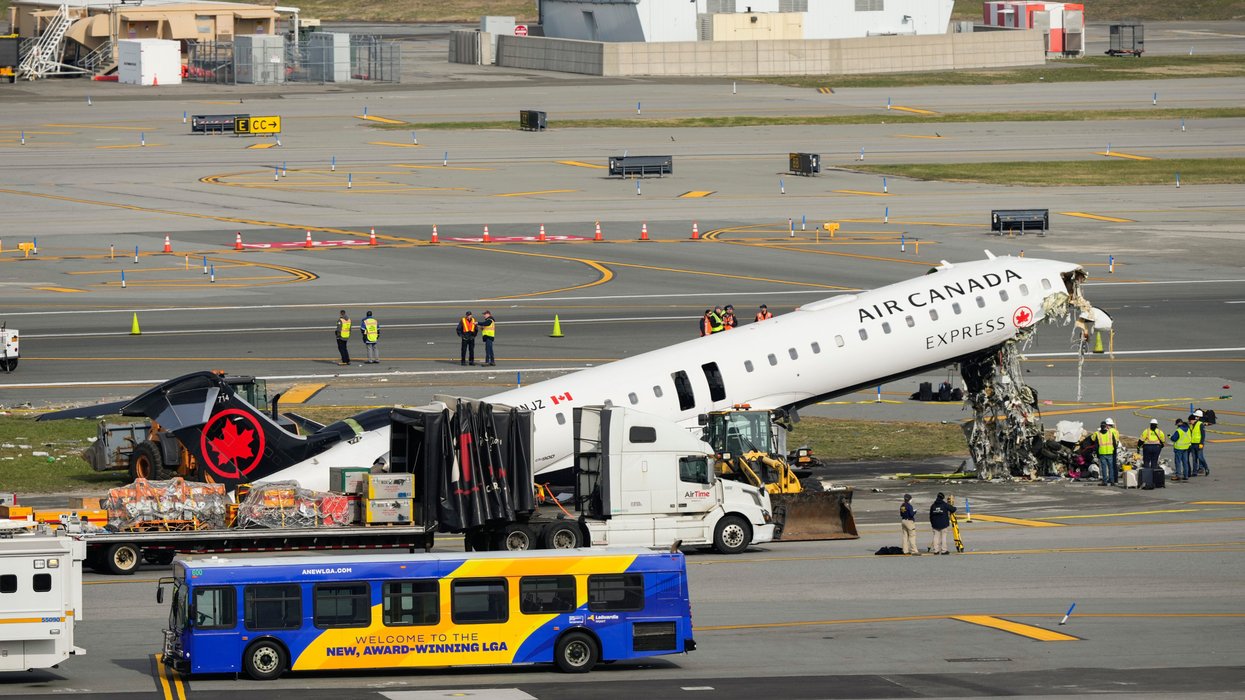
Officials inspect the wreckage of an Air Canada Express jet, Wednesday, March 25, 2026, just off the runway where it had collided with a Port Authority fire truck Sunday night at LaGuardia Airport in New York.
As experts assess the aftermath of the Air Canada Express plane crash at LaGuardia Airport, some have expressed surprise it wasn't worse — despite the tragedy of a disaster that left two pilots dead.
Commercial aircraft are constructed for flight, not for withstanding head-on collisions with fire trucks that can weigh between 25 and 50 tonnes, said Benoit Gauthier, a retired pilot who flew with Air Canada for 37 years.
A fully loaded Bombardier CRJ-900 — the jet that collided with the truck late Sunday night — weighs about 38 tonnes.
IN CASE YOU MISSED IT:
• 2 are dead after an Air Canada plane from Montreal crashed at New York's LaGuardia Airport
• US officials say a key warning system failed before the deadly Air Canada plane crash
• Mark Carney called out Air Canada CEO's English-only condolences after deadly plane crash
"Airplanes are basically built to deal with air. And cockpit domes, especially the bottom part, most of it is fibreglass or some sort of composite plastic," Gauthier said.
"There's not that much metal in there. If you hit anything solid ... it would basically destroy it, which is what happened."
The fuselage, which is the main body of a plane, can handle glancing blows at lower speeds while the landing gears and subflooring are made with shock absorption in mind during emergency landings. But the aluminum alloy and carbon fibre that comprise much of the central structure and cladding of commercial jets aim for lightness, with minimal energy-absorbing capacity in the nose of the plane.
"That the fuselage of the aircraft sustained damage only as far back as the front door of the airplane is a miracle," said John Gradek, who teaches aviation management at McGill University.
He attributed the outcome to both the quick braking of the pilots and the fact the front of the plane jolted upward upon impact, which deflected some of the kinetic energy that would have rippled through the 36-metre-long airliner.
"The airplane tilted up and all the energy dissipated without going through the airplane. But if it had stayed level and gone through the truck, there would have been much more damage, much more death," Gradek said.
Shortly after 11:30 p.m. on Sunday, an air traffic controller cleared Air Canada Express Flight 8646 to land less than two minutes before clearing a fire truck to cross the active runway, resulting in a collision that left two Canadian pilots dead and sent more than 40 people to hospital.
Footage shows the jet speeding along the rain-streaked strip as the truck crosses its path, veering away too late from an impact that unleashed a trail of smoke and debris as the plane skidded more than 100 metres farther, its cockpit crumpled.
The controller recognized the danger moments beforehand, instructing the truck to "stop" — 12 times in 10 seconds — but receiving no reply.
Reflecting on the tragedy, Gauthier said: "In my 42 flying years, I never had anything remotely close to that on landing or takeoff."
This report by The Canadian Press was first published March 25, 2026.
- Mark Carney called out Air Canada CEO's English-only condolences after deadly plane crash ›
- US officials say a key warning system failed before the deadly Air Canada plane crash ›
- 2 are dead after an Air Canada plane from Montreal crashed at New York's LaGuardia Airport ›
- Air Canada's CEO says he's 'deeply saddened' after French language backlash - MTL Blog ›
- Air Canada's CEO is stepping down after deadly plane crash & French language controversy - MTL Blog ›