Canada Has Updated Its Travel Advisory For France — Here's What You Need To Know
Ongoing protests will likely affect your visit.
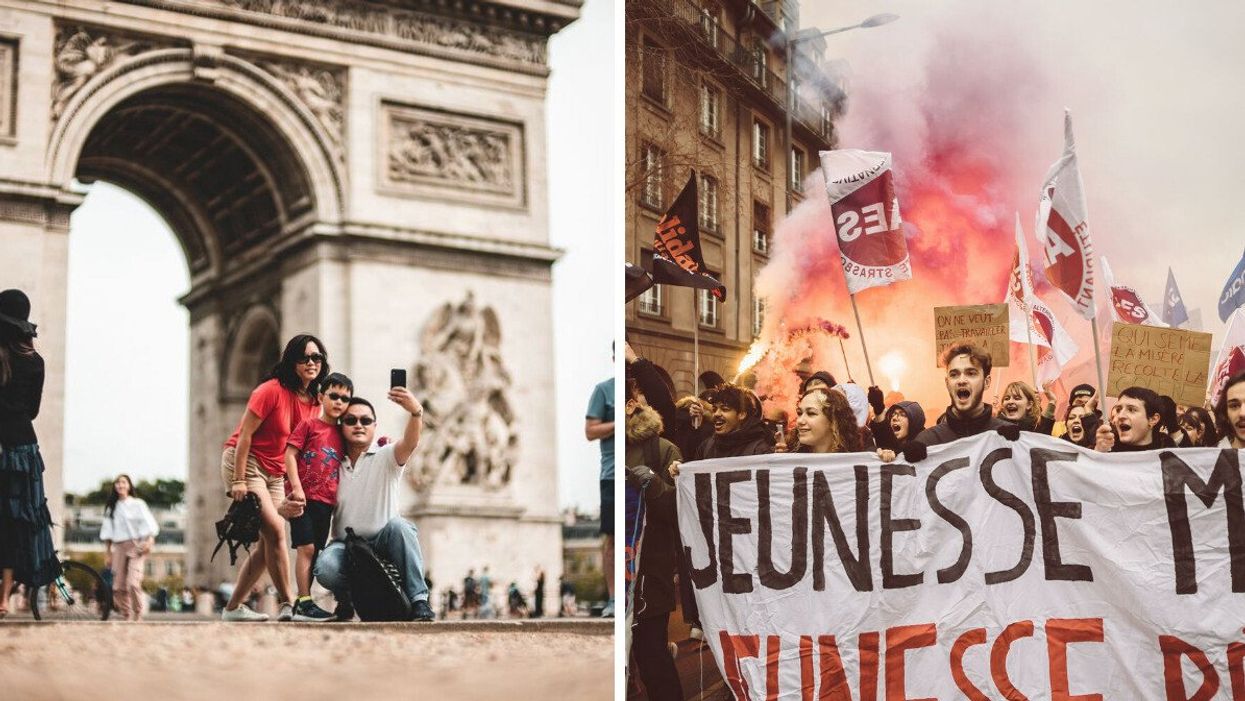
Tourists take a photo in front of the Arc du Triomphe. Right: French protesters march against pension reforms as a smoke grenade goes off in the background.
Strikes are shaking up cities across France, and Canadians planning to visit the European nation should stay on high alert. A government travel advisory warns that ongoing protests over pension reform in the country could disrupt tourist services and that even peaceful demonstrations can turn violent.
Popular destinations in Paris such as the Eiffel Tower and the Louvre were forced to close this week by striking workers, while the renowned wine city of Bordeaux saw its city hall set aflame by angry residents.
Here's what you should know about the current situation in France and how it could thwart an upcoming trip:
Are Canadians allowed to travel to France?
Canada advises that travellers to France "exercise a high degree of caution." The government has put the country on yellow alert, meaning there are "safety and security concerns or the situation could change quickly."
Those already in France should expect beefed-up security measures and extra police presence. Canada recommends staying tuned to local media for updates and being ready to make quick itinerary changes.
Why are there protests in France?
Demonstrations over pension reform have rocked the country since January, flaring up in March. French President Emmanuel Macron's proposal to raise the retirement age for most workers from 62 to 64 has angered trade unions and many young people.
Ensuing protests have caused significant disruptions in cities across the country with demonstrators clashing often with police. Recent actions temporarily closed the Eiffel Tower, Palace of Versailles and the Louvre in Paris. Meanwhile, garbage in the capital has been piling up for weeks as sanitation workers remain on strike.
Which parts of France are most affected by protests?
France's major cities, including Paris, Lyon, Marseille, Lille and Bordeaux face ongoing protests as unions declare nationwide strikes.
Some demonstrations in recent days have been unannounced and held spontaneously in city centres. Per Le Monde, around 740,000 people took to the street across the country on March 28 leading to clashes between security forces and protesters.
The next wave of union-mandated protests is expected on April 6.
How is transportation in France impacted by the protests?
Airports like international hub Charles de Gaulle and regional Orly and Biarritz sites have each been targeted and blocked by demonstrators, leading to significant flight delays, according to various outlets.
In Paris, trains at the Gare de Lyon station were interrupted by protesters walking on the rails. The downtown metro service also reports frequent strike-related shutdowns since the start of the year. Around 90% of TGVs, and a quarter of inter-city high-speed trains, are canceled on strike days.
Before you get going, check out our Responsible Travel Guide so you can be informed, be safe, be smart, and most of all, be respectful on your trip.
- Canada Has Issued Travel Advisories For These High-Risk Holiday Hotspots In Europe ›
- A New Map Tells Travellers Which Countries To Avoid In 2023 ›
- Canada Has Issued Travel Advisories For These Popular Vacation Spots In 2023 ›
- Flair Airlines Is Having A Flash Sale & You Can Fly From Montreal To Vancouver For $59 - MTL Blog ›
- There's A Sweet Spot For Scoring Cheap Plane Tickets — Here's When To Book - MTL Blog ›
- Canada Has Issued Travel Advisories For These Popular Summer Destinations - MTL Blog ›
- Canada Has Issued Travel Advisories For These 9 Vacation Destinations - MTL Blog ›
- Canada Updated Its Travel Advisories & Canadians Should Avoid This Caribbean Destination - MTL Blog ›