Raises in Quebec will be the lowest in Canada next year — unless you work these jobs
If you've been counting on a big raise to help catch up with rent and grocery bills, you might want to manage your expectations heading into 2027.
According to the new 2027 Salary Guide from staffing firm Randstad Canada, base salary increase budgets across the country are expected to hold steady at an average of 3.1% to 3.3% next year. And Quebec is at the very bottom of that range.
Alberta and British Columbia are leading the way with projected increases of 3.4%. Ontario, Manitoba, New Brunswick and Nova Scotia follow at 3.2%. Quebec comes in last at 3.1%.
That doesn't mean everyone in the province is in for a small bump, though. More and more, employers are saving their biggest raises for people with skills that are hard to find.
Raises are getting a lot more targeted
The guide, released on October 13, includes salary data for more than 600 positions across 15-plus industries, including a breakdown for Montreal.
One of its biggest takeaways is how rare across-the-board raises have become. Only 4% of Canadian companies still plan to give the same increase to everyone. Instead, employers are directing more of their budgets toward top performers and roles that are tough to fill.
Some industries are faring better than others. Professional services is leading the country with a projected 3.7% increase, followed by banking, finance and insurance at 3.6%.
Part of the reason budgets are tight comes down to the economy. Randstad says businesses are dealing with squeezed margins, thanks to U.S. tariffs averaging 5% on exports and a Canadian dollar sitting at around 71 cents U.S., which drives up import costs.
And there's a big gap in how employers and workers are feeling about the year ahead. While 98% of Canadian employers say they're confident about business growth heading into 2027, only 49% of workers share that optimism.
Workers are also feeling the pinch at home. According to Randstad, 36% of Canadians have taken on or are actively looking for a second job to keep up with the rising cost of living.
The top-paying Montreal jobs to watch
The biggest salaries in the guide go to a handful of in-demand roles, especially in tech and AI. Here's what senior-level workers in Montreal, those with eight to 12 years of experience, could earn in 2027:
- CISO/CTO/CIO: $263,000 to $456,900 a year
- Marketing vice-president: $250,300 to $386,800 a year
- AI governance specialist: $243,300 to $292,700 a year
- AI solutions architect: $217,600 to $284,500 a year
- AI agent architect: $160,400 to $209,600 a year
- HR manager: $145,400 to $192,800 a year
- Controller: $144,800 to $185,400 a year
- Data scientist: $135,600 to $179,000 a year
- Full-stack developer: $126,400 to $165,800 a year
In tech, Randstad says base raises are slowing down overall. But workers who can use AI to automate parts of a company's work are earning a premium.
AI is changing things, but not everyone trusts it
AI is a big theme throughout the report.
Sixty-two per cent of Canadian employers expect AI to transform between half and all of their teams' day-to-day tasks. And while 57% of workers say AI makes them more productive, 46% worry the gains will mostly benefit company profits instead of their own paycheques.
Meanwhile, nearly half of workers (49%) said they'd turn down an offer from an employer that doesn't have a structured upskilling program.
So if you're planning to ask for a raise next year, it might be worth leading with your skills, not just your years on the job.
What some everyday Montreal jobs pay
Not working in AI? The guide also covers a long list of more common jobs. Here's what senior-level workers in Montreal could make in some of them:
- Pharmacist: $133,500 to $168,100 a year
- Registered nurse: $93,400 to $119,600 a year
- Accountant: $86,000 to $112,400 a year
- Graphic designer: $76,100 to $100,600 a year
- Administrative assistant: $55,300 to $72,600 a year
- Customer service representative: $54,300 to $70,500 a year
- Electrician: $34.40 to $45.70 an hour
- Heavy equipment mechanic: $32.40 to $50 an hour
- Millwright: $32.90 to $42 an hour
You can look up your own role in the full Salary Guide.
AI tools may have been used to support the creation or distribution of this content; however, it has been carefully edited and fact-checked by a member of MTL Blog's Editorial team. For more information on our use of AI, please visit our Editorial Standards page.
- Montreal recorded over 500 break-ins in September — Here's which side of town got hit hardest ›
- Canada's friendliest cities were ranked and Montreal finished in a surprising spot ›
- A Quebec prisoner got McDonald's & booze delivered by drone to Canada's highest-security unit - MTL Blog ›
- Montreal's iconic Mount Royal cross is gone from the skyline — Here's what happened to it - MTL Blog ›
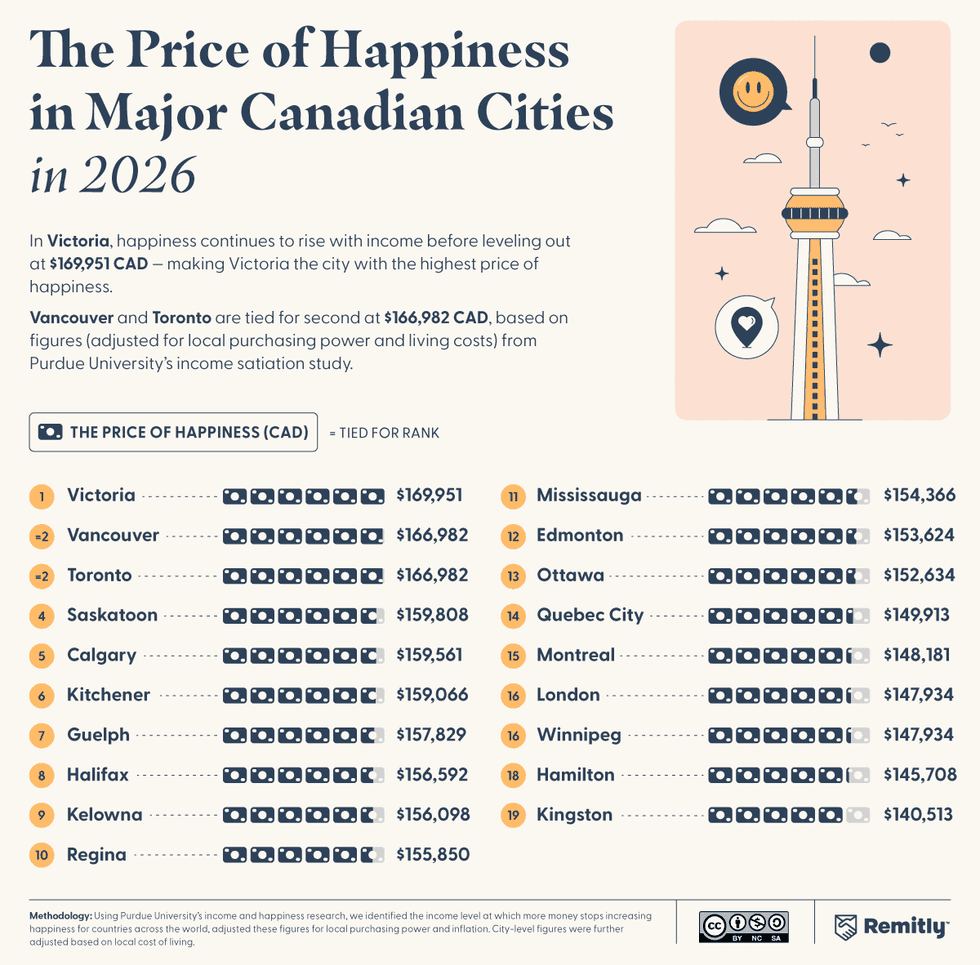 The price of happiness in different Canadian cities, 2026. Remitly